“If I don’t feel doubt, I’m going to be in trouble. Doubt is very important to my success.”
-Rafael Nadal
If you know anything about the game of tennis, you would be sure to take Rafa Nadal’s words pretty seriously. But when I heard Nadal say this in a 60 Minutes interview, I must say that I was a little bit surprised. Rafa Nadal, one of the greatest tennis players of all time, saying that doubt is a good thing? Certainly not what I was expecting. I immediately asked myself: “Why would Rafa say that self-doubt is a necessary attribute for a tennis player?”
Rafa explained that nerves are key to a tennis player being alert and ready for the constant changes that occur during the course of a tennis match. Having a certain degree of nerves makes you stay on edge, allowing you to reach your full potential and peak performance.
I thought about how Nadal’s words apply to myself as a tennis player, and I have come to realize that the topic of nerves and self-doubt is something that directly relates to my tennis career. As I talked about in my last tennis article, I have a meticulous personality, always adhering to a specific routine exactly as planned. In preparation for an important tennis match, I make sure to follow an intense warm-up routine so that I am ready for optimal performance. However, despite considering myself to be a bundle of nerves, I have learned a lot about how these nerves must be handled. Throughout my tennis career, I have grown to make it a part of my journey to work on controlling this part of my game.
As Rafa said, nerves are good. But based on my experience, they are only good to a certain extent. Having self-doubt can be used as a power; but if it gets to the point where that self-doubt is holding you back, then those nerves have become detrimental. Finding the balance between being too carefree and too uptight is a struggle that resonates with me as a tennis player. I have had a great amount of success with it, while also having some unfortunate shortcomings.
The name of my website indicates that tennis and politics are my strongest passions. This is true, but I also have a strong affinity for psychology. I would like to allude to a psychological concept that is pertinent to this article: the Yerkes-Dodson law. Originally developed by psychologists Robert M. Yerkes and John D. Dodson in 1908, this law explains a nuanced empirical relationship between pressure (tension, arousal, and/or anxiety) and performance. Essentially, the law states that we are able to perform better when there is increased mental or physiological arousal, but only to a certain extent. If this arousal goes overboard, it causes our performance levels to fall off a cliff. The bell curve shown below illustrates this psychological phenomenon.
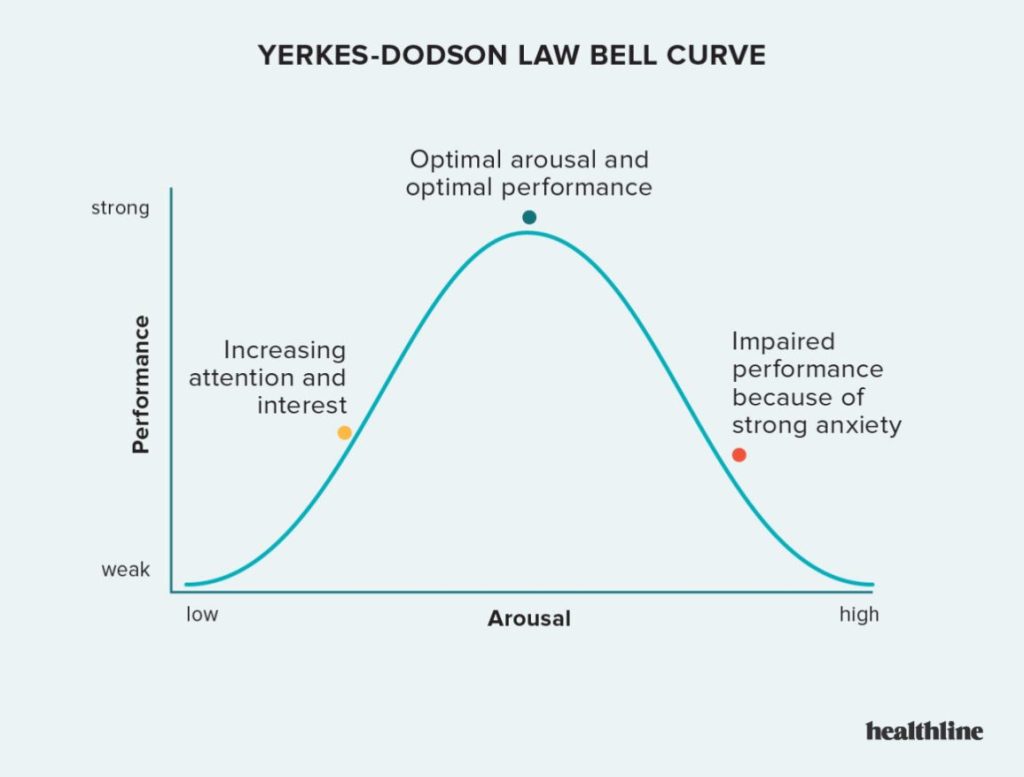
The Yerkes-Dodson law applies to so much more than just tennis. It pertains to nearly every aspect of life that we can think of. You need to have a certain degree of nerves (arousal), but it must be controlled. If you become overly stressed or anxious, it can lead to impaired performance.
As a student-athlete, I always enjoy finding meaningful comparisons between my experiences on the tennis court and in the classroom. There are countless similarities between taking a test in school and playing a match on the court. The Yerkes-Dodson law applies perfectly to both situations.
When you take a test, you have to go in with a mindset that you are ready to take a challenging assessment that you have tried your best to prepare for. You cannot just walk into the classroom completely relaxed and unfocused, as this could lead to careless errors and a potentially poor result on the test. However, it also cannot get to the point where you are so anxious and fearful of failure that it causes your concentration and performance to suffer.
That sounds a lot like performing in a tennis match (or any competitive sports competition, for that matter). The correlation could not be more clear.
There is nothing that I love more than competing. I love winning, and I hate losing. Ever heard of the saying that your greatest strength is also your greatest weakness? This can be directly applied to my game. My desire and determination to win propels me to compete hard and to perform well. But this intense hunger for victory can have some “side effects.” Finding a healthy equilibrium of emotion has been at the center of improving the mental aspect of my game, which is a critical part of my long-term development.
As I always do with my tennis articles, I feel duty-bound to connect my experiences and lessons as a tennis player to my life as a human being. As we all know, life is filled with challenges where the answer is not always clear. If life were easy, there would be no need to be nervous about anything. Nerves and self-doubt are normal and necessary emotions that cannot be avoided. Nonetheless, overcoming mental barriers to performance is essential and goes so far beyond the tennis court, extending and applying to all aspects and events of life.
 All Things Tennis and Politics