The coronavirus pandemic has been one of the most polarizing events in modern American history. The politicization of the pandemic has been used as a tool by politicians for the advancement of their own agendas, at the expense of both the lives and livelihoods of the American people. However, the politicians are not the only ones who have been at the political forefront of the pandemic. The people themselves, as well as their political beliefs, also have a stake in what should be done in a public health crisis.

Contemporary political ideologies are based on the original dilemma and the modern dilemma. The original dilemma is the conflict between freedom and order, which are considered to be in conflict with one another: the more you have of one, the more you have to give up of the other. If you give the government more authority to establish a secure and orderly society, then the people must sacrifice some of their freedom. On the other hand, if you want to have more freedom, then the people must risk having a less orderly and secure society. This original dilemma is only half of what is needed to understand the current ideological spectrum.
Since promoting equality has recently become an objective of the government, the modern dilemma is the conflict between freedom and equality. Just like the old dilemma, the modern dilemma is a situation where more of one thing means less of the other. Essentially, if the government steps in to enforce some kind of equality among all citizens, then a degree of freedom must be given up by the people in order to make that a reality. For example, policies like social welfare and affirmative action are systems that implement equality, but must come at the expense of freedom from government control.

Let’s take it a step further by examining the different political ideologies. Every ideology is based on a unique combination of the original and modern dilemmas. Understanding the details and nuances of the different political philosophies is key to understanding why the pandemic has caused such political division. If you look at what the different political ideologies entail, you may be surprised with what they actually advocate, particularly when it comes to liberals and conservatives.
Below are the contemporary ideologies organized into a two-dimensional framework. Libertarianism and communitarianism are the two extremes, as the former is in favor of freedom for both dilemmas, while the latter supports both order and equality over freedom. Liberalism and conservatism are more moderate, as they both promote freedom, but only in one of the dilemmas. While liberals promote freedom over order but not over equality, conservatives promote freedom over equality but not over order.
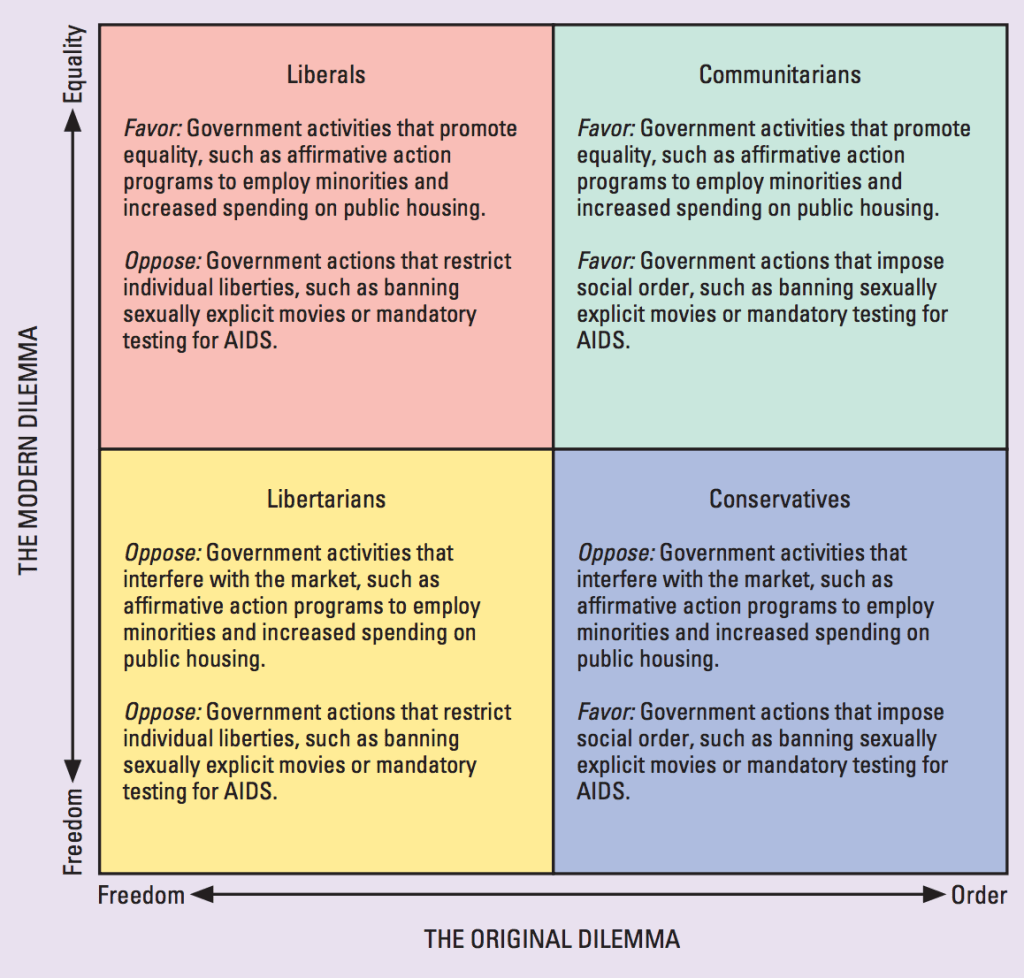
We tend to generalize the interests of liberals and conservatives based on the scope of government alone. The notion is that liberals support the government taking a more active role in society, while conservatives oppose “big government” and prefer that individuals be free from this kind of government overreach. But in reality, conservatives do not hesitate to use the government to promote order (but not equality), while liberals support freedom over order and are against “big government” forcibly maintaining the social order. An example of this is how liberals tend to be more tolerant to homosexual behavior. They are also in favor of more lenient laws that allow women the choice to get an abortion. They prefer the government to stay out of these kinds of situations. This means that there are certain instances when conservatives actually favor a larger scope of government, while liberals would be opposed. What defines these two ideologies is more complex than many people realize.
Let’s take a closer look at conservatives. If conservatives are all about “small government,” then why do they support the government stepping in to restrict abortion? Or to prevent same-sex marriage? Why do they support a strong police force (a sector of the government) to enforce the law and be tough on crime? Conservatives see all of these examples as justified uses of the government in order to ensure that the social order is maintained in all aspects. Did you notice how “mandatory testing for AIDS” is listed in the quadrant system above as something that conservatives favor? Well, this makes perfect sense, since conservatives support order over freedom. During the AIDS pandemic, required testing was seen as a protective measure against HIV, which would in turn maintain the safety of citizens and the social order as a whole. However, mandatory testing programs were faced with severe backlash from those who argued that they infringed on their individual rights. Based on the ideology spectrum, conservatives would support such testing programs, while liberals would be opposed.
How does this apply to the COVID-19 pandemic? We can make some significant parallels between the AIDS pandemic of the 1980s and the COVID pandemic today. Popular political labels in America tend to paint liberals as being in favor of policies like mask mandates, vaccine mandates, and stronger government regulation. These “liberal” policies are meant to keep people safe from the virus and in turn maintain societal safety. On the other hand, conservatives tend to be seen as vehemently opposed to such mandates, as they are perceived as flagrant violations of their individual liberties. But aren’t conservatives in favor of maintaining the social order, even if it comes at the expense of individual freedom? That right there is the essence of my argument: the COVID-19 pandemic has turned conservatives into libertarians.
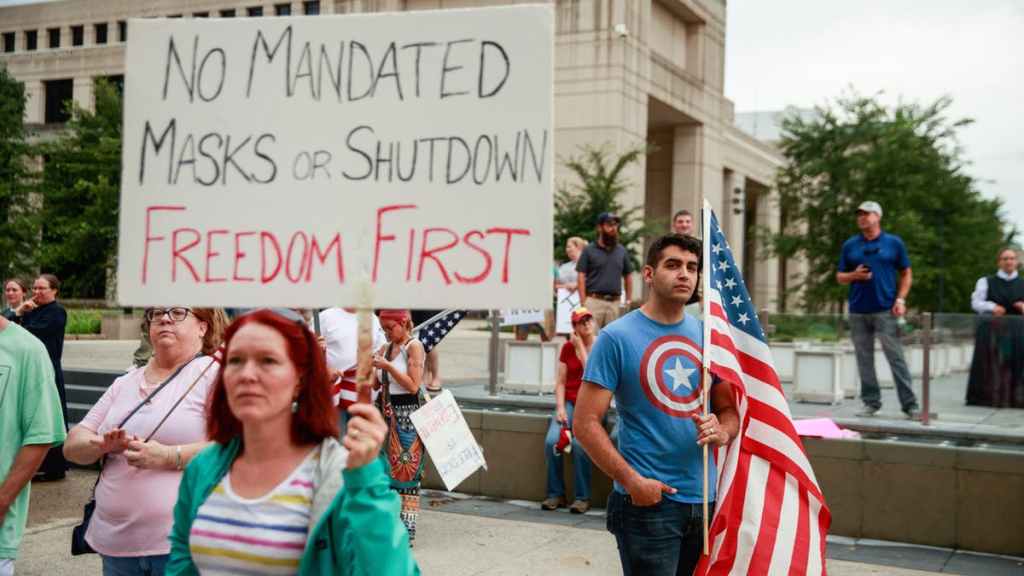
Conservatives and libertarians agree on one thing for certain: freedom over equality. They are both opposed to social welfare programs and policies that promote the redistribution of wealth, as these systems enforce social and economic equality at the expense of individual freedom. But libertarians are also opposed to government measures that maintain the social order, while conservatives are supposed to be in favor of those kinds of policies. If the “conservatives” of 2021 really live up to their name, they would actually support government mandates that would protect the social order, which includes the safety of the community during a public health crisis. Conservatives and Republicans have the right to oppose these government mandates; all I am saying is that they are promoting libertarian ideas, not conservative.
I would like to add another important point to my argument: today’s “liberals” are actually not so liberal according to the political quadrant system. At least in the context of the pandemic, they are promoting ideas that are more communitarian than anything else. Liberals continue to support equality over freedom, but the pandemic has also made them in favor of order over freedom. This has taken the form of support for mask mandates, vaccine mandates, stricter lockdowns, and greater government control in protecting the health and safety of society. This places “liberals” in the communitarian corner.
Let’s go back to conservatives and libertarians. Why does this even matter? Isn’t this just a semantic difference between conservatives and libertarians? Well, I argue that this is a significant detail that is being overlooked. The fact that conservatives and Republicans are looking at the pandemic with a libertarian mindset raises some serious questions. First, what do conservatives really care about? Do they really value freedom above anything else? Are they willing to fight for individual liberties, even when the safety of the community and the social order is threatened? Second, what do conservatives define as “social order”? Do they not consider a pandemic a danger to the social order? That seems to be the mindset of many contemporary conservatives, since they value individual freedom over the general health and safety of society. Perhaps they recognize that the pandemic poses somewhat of a threat, but not a threat that is worth sacrificing their freedom for.
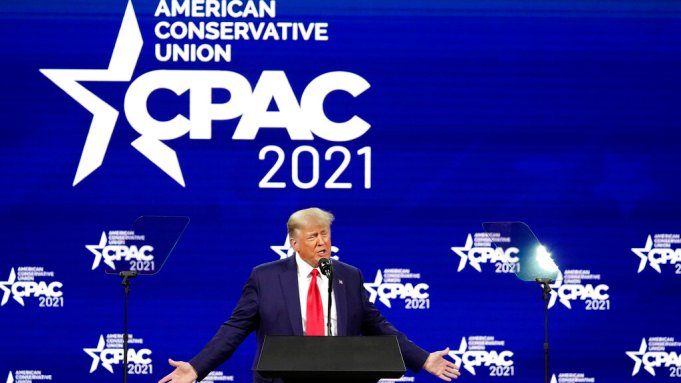
It is essential that we look at the bigger picture by examining the overarching consequences of the pandemic. Apart from the tragic loss of life, as well as the destruction of so many livelihoods, we can see how damaging the pandemic has been to the political climate of the country. In my first politics article, I talked about how America has been in a constant state of division since its founding. It is clear that this polarization has been exacerbated since Donald Trump got voted into office in 2016, and things only got worse during the pandemic. My theory states that in the context of pandemic policy, conservatives and Republicans have adopted a libertarian mindset, while liberals and Democrats have taken a communitarian approach. If my theory is correct, then the pandemic may be causing more political division than we realize.
As I said earlier, liberalism and conservatism are the more moderate ideologies on the political spectrum, while libertarianism and communitarianism are the extremes. If the pandemic really has caused Americans to abandon their moderate positions in favor of the more extreme ideologies, then the American people have become even more polarized than they were before. This is quite alarming.
Where do we go from here? Do we just wait for the pandemic to end and hope that everyone reverts to their moderate liberal and conservative positions? Ever since I got into politics, I have never seen America so divided. Perhaps it was inevitable, especially when Trump became president. The pandemic has driven this country into the ground, and drastic political division has been a detrimental side effect. But understanding where people stand ideologically is the least that we can do.
 All Things Tennis and Politics